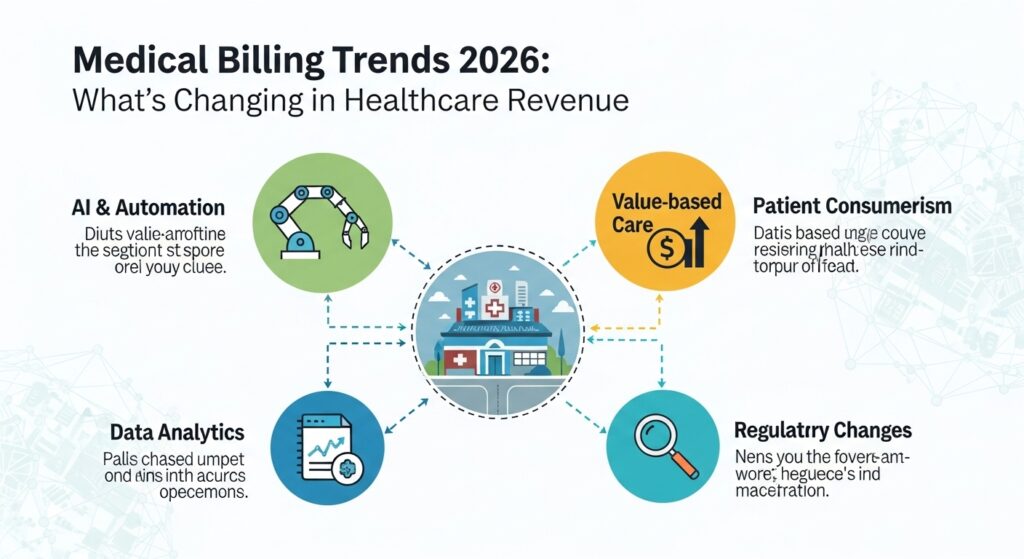
The healthcare industry is undergoing rapid transformation, and one of the most significant areas of change is medical billing. As providers face increasing regulatory demands, rising operational costs, and evolving patient expectations, understanding the Latest medical billing trends 2026 has become essential for financial sustainability. These trends are not only reshaping how claims are processed but also redefining how healthcare organizations manage revenue, compliance, and patient relationships.
In 2026, medical billing is no longer a purely administrative task. It is a strategic function closely tied to technology, data analytics, and patient experience. This article explores what is changing in healthcare revenue and how modern billing trends are shaping the future of the industry.
The Evolution of Medical Billing in 2026
Medical billing has evolved from manual paperwork and delayed reimbursements to intelligent, automated systems. The shift is driven by payer complexity, value-based care models, and advancements in digital health. Healthcare billing trends 2026 emphasize speed, accuracy, and transparency.
Providers now recognize that efficient billing is critical to maintaining cash flow and reducing revenue leakage. As a result, investments in technology and skilled professionals are increasing across healthcare organizations of all sizes.
Why Medical Billing Trends Matter for Healthcare Revenue
Healthcare revenue depends heavily on how effectively billing processes are managed. Errors, delays, and non-compliance can result in denied claims, lost revenue, and dissatisfied patients. The future of medical billing focuses on proactive strategies that prevent these issues before they occur.
Key drivers behind billing changes in 2026 include:
- Increased regulatory oversight
- Growth of telehealth and remote care
- Expansion of value-based reimbursement
- Higher patient financial responsibility
- Rapid adoption of digital tools
These factors are pushing billing systems to become smarter and more integrated.
Automation as the Foundation of Modern Billing
Healthcare billing automation is one of the most influential developments in 2026. Automated systems now handle tasks that were once manual and time-consuming, such as eligibility checks, claim submission, and payment posting.
Automation reduces human error, accelerates reimbursements, and lowers administrative costs. By minimizing repetitive tasks, billing teams can focus on complex issues like denial resolution and compliance monitoring.
Artificial Intelligence Transforming Billing Operations
AI in medical billing is playing a transformative role in revenue management. Artificial intelligence tools analyze vast amounts of billing data to identify patterns, predict denials, and optimize coding accuracy.
AI-driven systems can:
- Flag potential claim errors before submission
- Suggest corrective actions for denied claims
- Identify underpayments
- Improve payer-specific billing strategies
These capabilities significantly improve reimbursement rates and operational efficiency.
Data Analytics and Predictive Insights
Advanced analytics are now central to effective billing strategies. By analyzing historical and real-time data, providers can forecast revenue, monitor claim performance, and identify bottlenecks in billing workflows.
These insights directly support revenue cycle management trends 2026, enabling organizations to make informed decisions that enhance financial performance and reduce revenue loss.
The Impact of Value-Based Care on Billing
Value-based care models continue to expand in 2026, shifting reimbursement from volume to outcomes. This transition has a profound impact on medical billing, requiring more detailed documentation, accurate coding, and performance reporting.
Billing teams must collaborate closely with clinical staff to ensure that services are documented correctly and aligned with payer requirements. This integration is essential for success under value-based reimbursement models.
Medical Coding Advancements in 2026
Accurate coding remains the backbone of successful billing. In 2026, coding processes are becoming more sophisticated with the use of AI-assisted tools and frequent updates to coding guidelines.
These advancements align with medical coding trends 2026, where automation enhances efficiency while experienced coders ensure compliance and accuracy. The balance between technology and human expertise is critical in minimizing errors and maximizing reimbursements.
Compliance Challenges and Solutions
Medical billing compliance 2026 is more complex than ever. Regulatory requirements continue to evolve, and enforcement is becoming stricter. Non-compliance can lead to audits, penalties, and reputational damage.
To address these challenges, billing systems now include built-in compliance checks that monitor coding accuracy, documentation standards, and submission timelines. Regular training and audits are also essential to maintaining compliance.
Patient-Centered Billing Experiences
Patients are increasingly viewed as healthcare consumers, and their expectations are shaping billing practices. Confusing bills and lack of transparency can lead to delayed payments and dissatisfaction.
Modern billing systems focus on:
- Clear and itemized statements
- Digital payment options
- Real-time cost estimates
- Flexible payment plans
These improvements reflect broader medical billing updates 2026, where patient experience is a key component of revenue management.
Integration Across Healthcare Systems
Interoperability is a major focus in 2026. Billing systems are now integrated with electronic health records (EHRs), practice management platforms, and payer systems. This integration ensures seamless data flow, reducing errors and speeding up claims processing.
Such connectivity strengthens revenue cycle management trends 2026, allowing organizations to manage revenue more effectively from patient intake to final payment.
The Role of Outsourcing and Hybrid Models
Many healthcare providers are adopting hybrid billing models that combine in-house teams with external billing partners. Outsourcing allows access to specialized expertise, advanced technology, and scalability without significant infrastructure investment.
This approach supports organizations navigating the complexities of medical billing technology trends while maintaining control over critical operations.
Cybersecurity and Data Protection
As billing systems become more digital, protecting sensitive patient and financial data is a top priority. Cybersecurity measures in 2026 include encryption, multi-factor authentication, and regular system audits.
Strong data protection is an essential part of medical billing compliance strategies and helps build trust with patients and payers alike.
Telehealth Billing Continues to Evolve
Telehealth remains a permanent component of healthcare delivery. Billing for virtual services requires accurate documentation, correct modifiers, and adherence to payer-specific rules.
Billing teams must stay updated with telehealth reimbursement policies as part of adapting to medical billing trends 2026.
Denial Management Becomes Proactive
Denials are a major source of revenue loss. In 2026, AI-driven denial management tools analyze claim data to identify potential issues before submission.
These tools improve first-pass acceptance rates and reduce rework, directly enhancing revenue performance.
Workforce Transformation in Medical Billing
While automation reduces manual workload, skilled billing professionals remain essential. In 2026, billing staff are expected to understand analytics, manage AI tools, and ensure compliance.
Continuous education and training are critical to keeping pace with medical billing technology trends and regulatory changes.
Cost Transparency and Financial Responsibility
With rising deductibles and out-of-pocket costs, patients demand transparency. Billing systems now provide upfront cost estimates and clear explanations of benefits, reducing confusion and improving payment rates.
This transparency supports both patient satisfaction and financial stability.
Global Influence on Billing Practices
Healthcare organizations are increasingly adopting global best practices in billing, such as standardized coding and automated workflows. These practices improve efficiency and align with international compliance standards.
Challenges That Remain in 2026
Despite technological advancements, challenges persist:
- Rapid regulatory changes
- Integration costs
- Data security risks
- Resistance to new technologies
Addressing these challenges requires strategic planning and ongoing investment.
Preparing for the Future of Healthcare Revenue
To succeed in 2026 and beyond, healthcare providers should:
- Invest in automation and AI
- Strengthen compliance programs
- Focus on patient-friendly billing
- Leverage data analytics for decision-making
These steps ensure alignment with evolving billing trends and long-term financial health.
Final Thoughts
The Latest medical billing trends 2026 are fundamentally changing how healthcare organizations manage revenue. From automation and AI to patient-centered billing and compliance-first strategies, these trends are shaping a more efficient, transparent, and sustainable healthcare system.
By embracing innovations aligned with medical billing trends 2026 and focusing on integrated revenue cycle management, healthcare providers can improve cash flow, reduce risk, and deliver better experiences for patients. The future of healthcare revenue lies in smarter billing—and 2026 marks a pivotal year in that transformation.