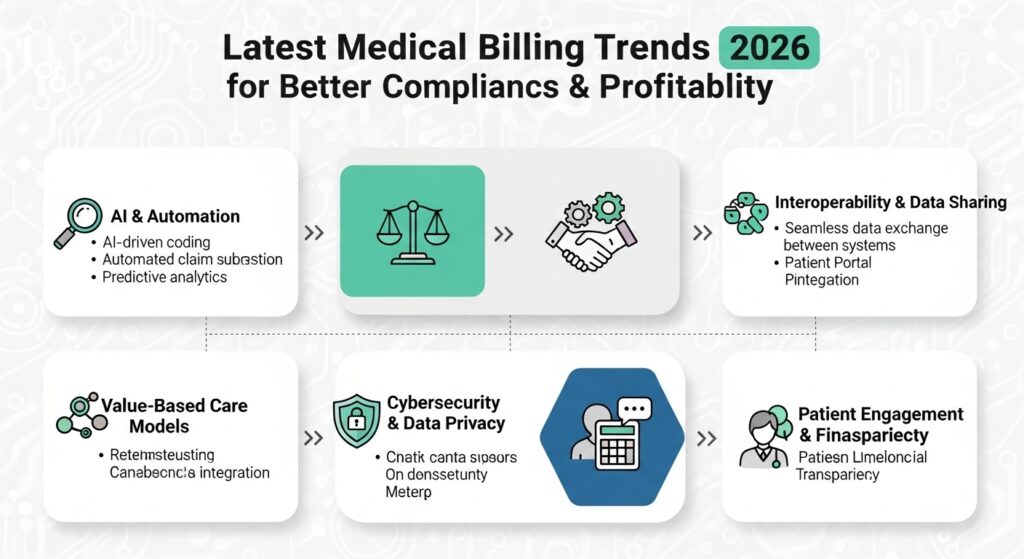
The healthcare industry is entering a new era where financial performance and regulatory compliance are more closely linked than ever. As providers, hospitals, and billing professionals prepare for the future, understanding the Latest medical billing trends 2026 is critical to maintaining profitability while meeting increasingly complex compliance standards. Medical billing is no longer just a back-office function—it has become a strategic pillar of sustainable healthcare operations.
In 2026, rapid technological innovation, evolving payer requirements, and growing patient expectations are transforming how healthcare revenue is managed. This article explores the most important trends shaping medical billing in 2026 and explains how organizations can leverage them for better compliance and stronger financial outcomes.
Why Medical Billing Is Changing So Rapidly
Healthcare billing has always been complex, but the pace of change has accelerated dramatically. Several factors are driving this transformation:
- Stricter regulatory enforcement
- Expansion of value-based care models
- Increased use of telehealth services
- Higher patient financial responsibility
- Advancements in automation and artificial intelligence
These drivers have given rise to new healthcare billing trends 2026 that focus on accuracy, efficiency, and transparency across the revenue cycle.
Automation as the Backbone of Modern Billing
Healthcare billing automation is one of the most influential developments in 2026. Automated tools now handle tasks such as eligibility verification, claim submission, payment posting, and follow-ups with minimal human intervention.
Automation improves profitability by reducing errors, shortening reimbursement cycles, and lowering administrative costs. From a compliance perspective, automated workflows ensure consistent adherence to payer rules and documentation requirements.
This shift is a defining feature of medical billing technology trends, enabling billing teams to focus on higher-value tasks like audits, appeals, and performance analysis.
Artificial Intelligence Driving Smarter Billing Decisions
AI in medical billing has moved beyond experimentation and is now a core operational tool. In 2026, AI-powered systems analyze historical and real-time billing data to predict denials, identify underpayments, and recommend corrective actions.
AI helps organizations achieve better compliance by flagging potential coding or documentation issues before claims are submitted. At the same time, it boosts profitability by improving first-pass claim acceptance rates and accelerating cash flow.
Data Analytics and Revenue Optimization
Advanced analytics play a central role in modern billing strategies. Billing leaders rely on dashboards and reports to track key performance indicators such as denial rates, days in accounts receivable, and payer-specific trends.
These insights directly support revenue cycle management trends 2026, allowing organizations to proactively address inefficiencies and prevent revenue leakage. Data-driven decision-making is now essential for both financial stability and regulatory compliance.
Value-Based Care and Its Impact on Billing
Value-based care continues to expand in 2026, reshaping how providers are reimbursed. Instead of being paid solely for services rendered, providers are increasingly compensated based on outcomes and quality metrics.
This shift requires more detailed documentation, accurate coding, and close coordination between clinical and billing teams. Billing systems must be capable of capturing performance data and aligning it with payer requirements—an important aspect of the future of medical billing.
Advances in Medical Coding Practices
Accurate coding remains a cornerstone of successful billing. In 2026, coding processes are enhanced by AI-assisted tools that suggest appropriate codes based on clinical documentation.
However, human expertise remains essential to ensure compliance and handle complex cases. These developments align with medical coding trends 2026, where technology and skilled professionals work together to reduce errors and maximize reimbursement.
Strengthening Compliance in a Complex Regulatory Environment
Medical billing compliance 2026 is more challenging due to frequent updates in payer policies, government regulations, and audit requirements. Non-compliance can result in denied claims, financial penalties, and reputational damage.
To address these risks, billing systems now incorporate real-time compliance checks, automated audits, and standardized workflows. Regular staff training and internal reviews are also critical to maintaining compliance.
Patient-Centric Billing Becomes a Priority
Patients today expect clarity and transparency in healthcare billing. Confusing statements and unexpected charges lead to dissatisfaction and delayed payments.
Modern billing practices emphasize:
- Clear, itemized invoices
- Upfront cost estimates
- Digital payment options
- Flexible payment plans
These improvements are part of broader medical billing updates 2026, recognizing that patient experience directly affects revenue collection.
Interoperability and System Integration
In 2026, billing systems are deeply integrated with electronic health records (EHRs), practice management software, and payer platforms. This interoperability ensures seamless data exchange, reducing manual entry and errors.
Integrated systems enhance efficiency across the billing lifecycle and strengthen compliance by ensuring accurate and complete documentation.
Proactive Denial Management Strategies
Claim denials remain a major threat to profitability. In response, organizations are adopting proactive denial management tools that analyze claims before submission.
These tools identify potential issues related to coding, eligibility, or documentation, significantly reducing denial rates. Proactive denial management is a key component of medical billing trends 2026, supporting both revenue growth and compliance.
Cybersecurity and Data Protection in Billing Systems
As billing processes become increasingly digital, protecting sensitive patient and financial data is a top priority. Cybersecurity measures in 2026 include encryption, role-based access, and continuous monitoring.
Strong data protection practices are essential for compliance and help build trust with patients and payers.
Telehealth Billing Continues to Mature
Telehealth services are now a permanent part of healthcare delivery. Billing for virtual visits requires accurate use of modifiers, correct place-of-service codes, and adherence to payer-specific rules.
Staying current with telehealth billing policies is essential for organizations adapting to evolving healthcare billing trends 2026.
Workforce Evolution in Medical Billing
While automation and AI reduce manual workloads, skilled billing professionals remain indispensable. In 2026, billing staff are expected to interpret analytics, manage automated systems, and ensure regulatory compliance.
Continuous training is necessary to keep pace with medical billing technology trends and evolving regulations.
Cost Transparency and Patient Financial Responsibility
With rising deductibles and co-pays, patients are more financially responsible for their care. Billing systems now provide real-time cost estimates and eligibility checks, helping patients understand their financial obligations upfront.
This transparency improves payment rates and enhances patient satisfaction.
Global Best Practices Influencing Billing
Healthcare organizations are increasingly adopting global best practices such as standardized coding frameworks and automated compliance checks. These practices improve efficiency and align billing operations with international standards.
Challenges That Persist in 2026
Despite advancements, challenges remain:
- High implementation costs for new technology
- Rapid regulatory changes
- Data security risks
- Resistance to process change
Overcoming these challenges requires strategic planning and leadership commitment.
Preparing for Long-Term Success
To thrive in 2026 and beyond, healthcare organizations should:
- Invest in automation and AI
- Strengthen compliance frameworks
- Focus on patient-friendly billing
- Use analytics to guide decisions
These steps support alignment with revenue cycle management trends 2026 and long-term financial health.
Conclusion
The Latest medical billing trends 2026 highlight a clear shift toward smarter, more integrated, and compliance-driven billing systems. Automation, AI, advanced analytics, and patient-centric practices are no longer optional—they are essential for profitability and regulatory success.
By embracing innovations aligned with medical billing trends 2026 and focusing on compliance-first strategies, healthcare organizations can improve cash flow, reduce risk, and build a sustainable financial future. In an increasingly complex healthcare environment, effective medical billing is the key to both compliance and profitability.