
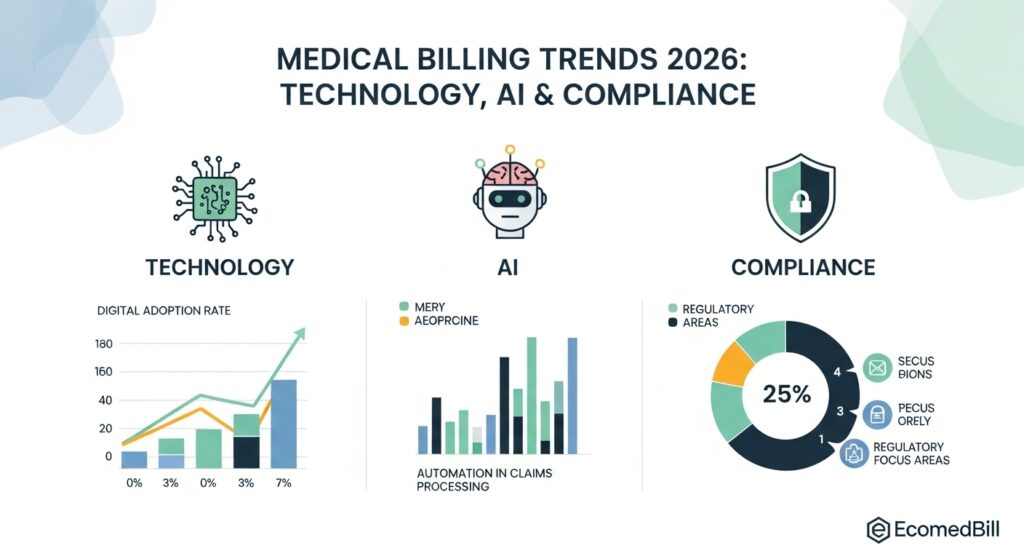
The healthcare industry is entering a transformative era, and medical billing is at the center of this change. As regulations evolve, patient expectations rise, and technology advances at unprecedented speed, providers must stay ahead of the curve. Understanding the Latest medical billing trends 2026 is no longer optional—it is essential for financial stability, compliance, and long-term growth.
In this in-depth guide by EcomedBill, we explore how technology, artificial intelligence (AI), automation, and compliance reforms are reshaping medical billing in 2026. Whether you are a healthcare provider, billing professional, or entrepreneur, this article will help you navigate what’s changing and how to prepare.
The Changing Landscape of Medical Billing in 2026
Medical billing has traditionally been a manual, complex, and error-prone process. In 2026, that reality is rapidly changing. The industry is shifting toward smarter systems that reduce denials, improve cash flow, and ensure regulatory compliance.
Several factors are driving this transformation:
- Increased regulatory scrutiny
- Growing use of AI and automation
- Demand for faster reimbursements
- Value-based care models
- Rising patient financial responsibility
Together, these forces are redefining workflows and expectations across the revenue cycle.
Technology as the Backbone of Modern Medical Billing
Technology is the foundation of modern billing operations. Cloud-based platforms, integrated EHR systems, and real-time analytics are now standard rather than optional.
Cloud-Based Billing Platforms
Cloud solutions allow billing teams to access data securely from anywhere. This improves collaboration, scalability, and disaster recovery while reducing infrastructure costs.
Interoperability & Data Integration
In 2026, billing systems must seamlessly integrate with EHRs, clearinghouses, and payer portals. Interoperability reduces duplicate data entry and minimizes claim errors.
Real-Time Analytics
Advanced dashboards provide insights into denial rates, aging AR, payer performance, and compliance risks—allowing proactive decision-making instead of reactive fixes.
Artificial Intelligence (AI) in Medical Billing
AI is one of the most disruptive forces shaping medical billing today. Its impact goes far beyond automation.
Predictive Claim Scrubbing
AI-powered claim scrubbing tools analyze historical data to predict errors before submission. This significantly reduces denials and rejections.
Intelligent Coding Support
AI assists coders by suggesting accurate CPT, ICD-10, and HCPCS codes based on clinical documentation, reducing undercoding and overcoding risks.
Automated Prior Authorizations
AI tools now streamline prior authorization workflows, cutting down delays and improving approval rates.
Fraud Detection
Advanced algorithms detect unusual billing patterns, helping providers stay compliant and avoid audits or penalties.
These innovations are a major part of the future of medical billing, where human expertise is augmented—not replaced—by intelligent systems.
Automation Across the Revenue Cycle
Automation is no longer limited to claim submission. In 2026, it spans the entire revenue cycle:
- Patient eligibility verification
- Charge capture
- Claims submission
- Payment posting
- Denial management
- Patient statements and follow-ups
By reducing manual intervention, automation improves accuracy, speeds up reimbursements, and lowers operational costs.
Compliance: A Top Priority in 2026
Compliance requirements are becoming more complex every year. HIPAA updates, payer-specific rules, and evolving CMS guidelines require constant vigilance.
HIPAA & Data Security
With increased digitization comes greater risk. Cybersecurity compliance is critical to protect patient data and avoid costly breaches.
Coding & Documentation Audits
Payers are increasing audits to combat fraud and abuse. Accurate documentation and coding are essential to withstand scrutiny.
Value-Based Care Compliance
As value-based care models expand, billing must align with quality metrics, outcomes reporting, and bundled payment structures.
Staying compliant with medical billing updates 2026 requires continuous training, updated systems, and expert oversight.
Value-Based Care & Its Impact on Billing
Fee-for-service models are gradually giving way to value-based care. This shift significantly impacts billing processes.
- Payments are tied to outcomes, not volume
- Claims require additional quality data
- Reporting requirements are more complex
Billing teams must adapt to new reimbursement structures while maintaining accuracy and compliance.
Patient-Centric Billing Trends
Patients are now active participants in their healthcare finances. Transparency and convenience are key expectations in 2026.
Clear Pricing & Estimates
Providers are expected to offer upfront cost estimates and explain patient financial responsibility.
Digital Payment Options
Online portals, mobile payments, and automated payment plans improve collections and patient satisfaction.
Simplified Statements
Clear, easy-to-understand statements reduce confusion and disputes.
These changes are a major part of evolving healthcare billing trends 2026, focusing on trust and transparency.
Outsourcing vs. In-House Billing in 2026
As billing becomes more complex, many providers are re-evaluating whether to keep billing in-house or outsource to experts.
Benefits of Outsourcing
- Access to certified billing specialists
- Reduced overhead costs
- Improved compliance and denial management
- Scalability for growing practices
This is why many practices partner with top medical billing companies to stay competitive.
Geographic Trends in Medical Billing Services
Billing needs and regulations can vary by state. For example, medical billing companies in Texas often specialize in high-volume practices and multi-specialty groups due to the state’s large healthcare market.
Understanding regional payer rules and Medicaid requirements is essential for accurate billing and compliance.
Entrepreneurial Opportunities in Medical Billing
The demand for expert billing services is creating new business opportunities. Many professionals are exploring how to start a medical billing company as a scalable and profitable venture.
Key success factors include:
- Knowledge of regulations and coding
- Investment in advanced billing software
- Hiring certified professionals
- Building payer relationships
While lucrative, it requires a deep understanding of compliance and technology.
Revenue Cycle Optimization in 2026
Revenue cycle performance is a top concern for healthcare organizations. In 2026, optimization strategies focus on:
- Front-end accuracy (eligibility, authorizations)
- Clean claim rates
- Faster AR turnaround
- Proactive denial prevention
These strategies are closely tied to latest medical billing trends 2026, emphasizing efficiency and predictability.
Role of Medical Coders in 2026
Despite automation, skilled medical coders remain indispensable. Their role is evolving from manual code entry to oversight, auditing, and complex case review.
Continuous education is essential as coding guidelines and payer rules change frequently.
Compliance Audits & Risk Management
Audits are increasing in frequency and scope. Providers must implement:
- Internal audits
- Regular compliance training
- Documentation best practices
- Risk assessment protocols
Proactive compliance reduces financial risk and protects reputation.
How EcomedBill Helps Providers Stay Ahead
EcomedBill combines technology, expertise, and compliance-focused workflows to help providers navigate complex billing environments. By aligning services with the future of medical billing, EcomedBill ensures:
- Reduced denials
- Faster reimbursements
- Full regulatory compliance
- Scalable billing solutions
Preparing for What’s Next
To stay competitive in 2026 and beyond, healthcare organizations should:
- Invest in AI-driven billing tools
- Prioritize compliance and security
- Train staff on new regulations
- Monitor performance metrics closely
- Partner with experienced billing experts
These steps align directly with emerging healthcare billing trends 2026 and position organizations for long-term success.
Conclusion
Medical billing in 2026 is defined by innovation, intelligence, and accountability. Technology and AI are streamlining workflows, while stricter compliance standards demand accuracy and transparency. Understanding the Latest medical billing trends 2026 is critical for providers who want to improve cash flow, reduce risk, and deliver better patient experiences.
As medical billing updates 2026 continue to reshape the industry, organizations that embrace change will thrive—while those that resist risk falling behind. With the right strategy, tools, and partners like EcomedBill, the future of medical billing is not just manageable—it’s full of opportunity.